
By the Standardize It team · Last reviewed: September 30, 2026
Most small business owners interview the way that feels natural: a friendly chat, a few questions and a gut call at the end. It’s human, but inconsistent. Every candidate gets a different interview, small talk can drift into personal topics, and later it’s hard to explain your choice.
This guide shows you how to conduct a structured interview, step by step. It’s written for small businesses and hiring managers in Canada outside Quebec who don’t have an HR department.
You’ll build a short interview guide, run every interview the same way, score answers against a simple rubric and document your decision.
If you’d rather not start from a blank page, our structured interview guide and scorecard is ready to download.
In this guide:
- What is a structured interview?
- Before the interview
- During the interview
- Questions to avoid in a Canadian job interview
- After the interview
- FAQ
What is a structured interview?
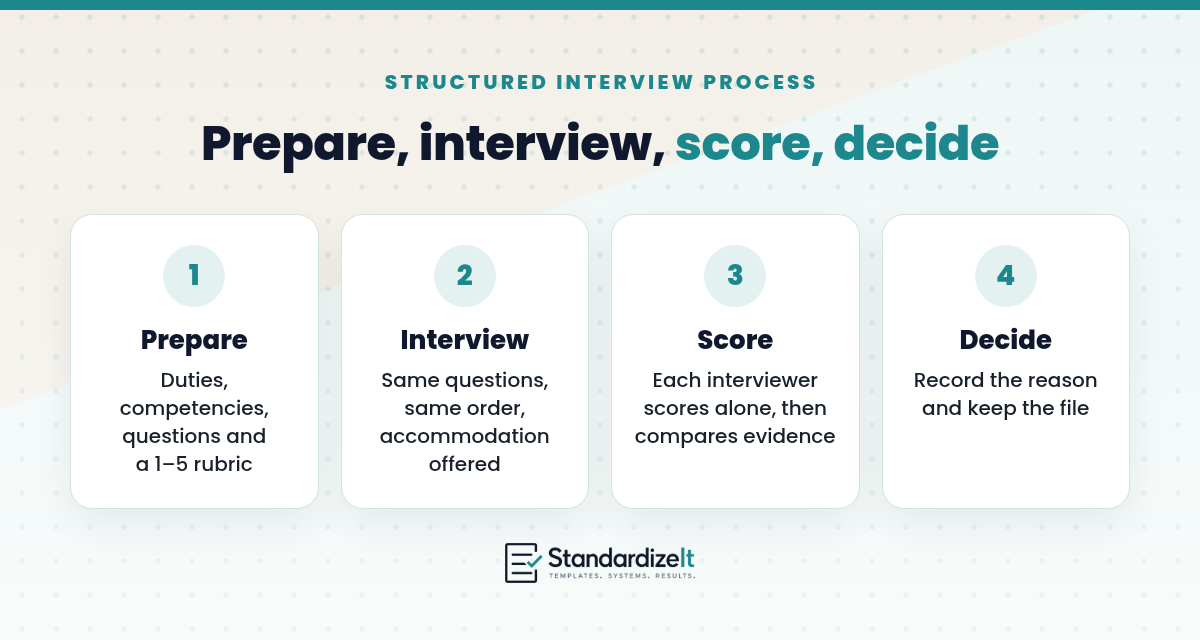
In a structured interview, every candidate for the same role:
- is asked the same core, job-related questions, in the same order
- has their answers scored against the same scale, which you set before the interviews
- is assessed by interviewers who score independently before comparing notes
- gets a documented, job-related reason for the outcome
Structured vs. unstructured interviews
An unstructured interview is a conversation that changes from candidate to candidate and ends in an overall impression. A structured interview uses set job-related questions, a scoring guide and written notes, so you compare answers to the same questions instead of different conversations.
Why it matters for small businesses
At a ten-person business, one hire changes the whole team. Structure gives you:
- Fairer comparisons. Everyone gets the same chance to show what they can do.
- Better hires. You measure the skills the job needs, not who was most fun to talk to.
- A written record. You can show the scores and evidence behind a choice.
- Consistency when you delegate. A team lead can run the process the way you would.
Human rights commissions encourage this kind of consistency. For example, the Ontario Human Rights Commission recommends preparing set questions in advance, asking every applicant the same questions, and scoring answers against an answer guide and marking scheme written before interviews start. BC’s Office of the Human Rights Commissioner also recommends structured interviews with the same predetermined questions for every applicant.
How to conduct a structured interview: before the interview
Most of the work happens before the interview. If you’re figuring out how to conduct an interview as an employer for the first time, start here. Build your interview guide once and reuse it for every candidate in that hiring round.
Step 1: Start from the job’s essential duties
List what someone genuinely needs to do the work: the skills, knowledge and behaviours that matter every day. If a requirement isn’t tied to the real work, don’t screen for it.
You’ll sometimes hear the term “bona fide occupational requirement.” Human rights law allows a requirement that excludes people on a protected ground only if the employer can show it’s genuinely needed: it’s connected to the job, it was adopted in good faith, and the employer can’t accommodate the person without undue hardship. That’s the test the Supreme Court of Canada set in 1999, often called the Meiorin test. (See also the Ontario Human Rights Commission on setting job requirements.)
Tip: write the steps down so the next hire is faster. See how to create an SOP for your business, or start from our free SOP template.
Before you post, check the job-posting and pay rules where you hire. Several provinces, including British Columbia, New Brunswick, Nova Scotia and Prince Edward Island, prohibit employers from asking job candidates about their pay history. That’s why the guide leaves pay-history questions out. Hiring in Ontario? See the Ontario section below.
Sources: BC Pay Transparency Act, NB Pay Transparency Act, NS Labour Standards Code, PEI Employment Standards Act.
Step 2: Pick 4 to 6 competencies to assess
Turn the duties into four to six competencies, such as problem solving, customer focus, teamwork or a technical skill. More than six and the scores get blurry.
Step 3: Write behavioural and situational questions
- Behavioural interview questions ask about real past experience: “Tell us about a time you…”
- Situational questions set up a realistic scenario from the job: “What would you do if…”
Write one main question per competency, plus one role-specific technical question. Let candidates draw examples from work, school, volunteering or anywhere else.
Behavioural interview question examples for common small-business roles
- Customer service: “Tell us about a time a customer was upset about something outside your control. What did you do, and how did it end?”
- Any role: “Tell us about a time a process or tool changed and you had to adapt quickly. How did you get up to speed?”
Step 4: Decide what a good answer looks like (the answer guide)
For each question, write a few “listen for” points about the work, not personal circumstances.
What strong answers look like, two examples:
- Problem solving (“an unexpected problem that affected a deadline or the people you served”). A strong answer defines the problem, explains the choice and action, and shares a result. A weak answer stays vague or blames others.
- Collaboration (“someone with a different working style or a conflicting priority”). A strong answer shows listening, adapting and a shared result. Watch for stories about winning an argument.
Step 5: Set a scoring rubric (1 to 5, with anchors)
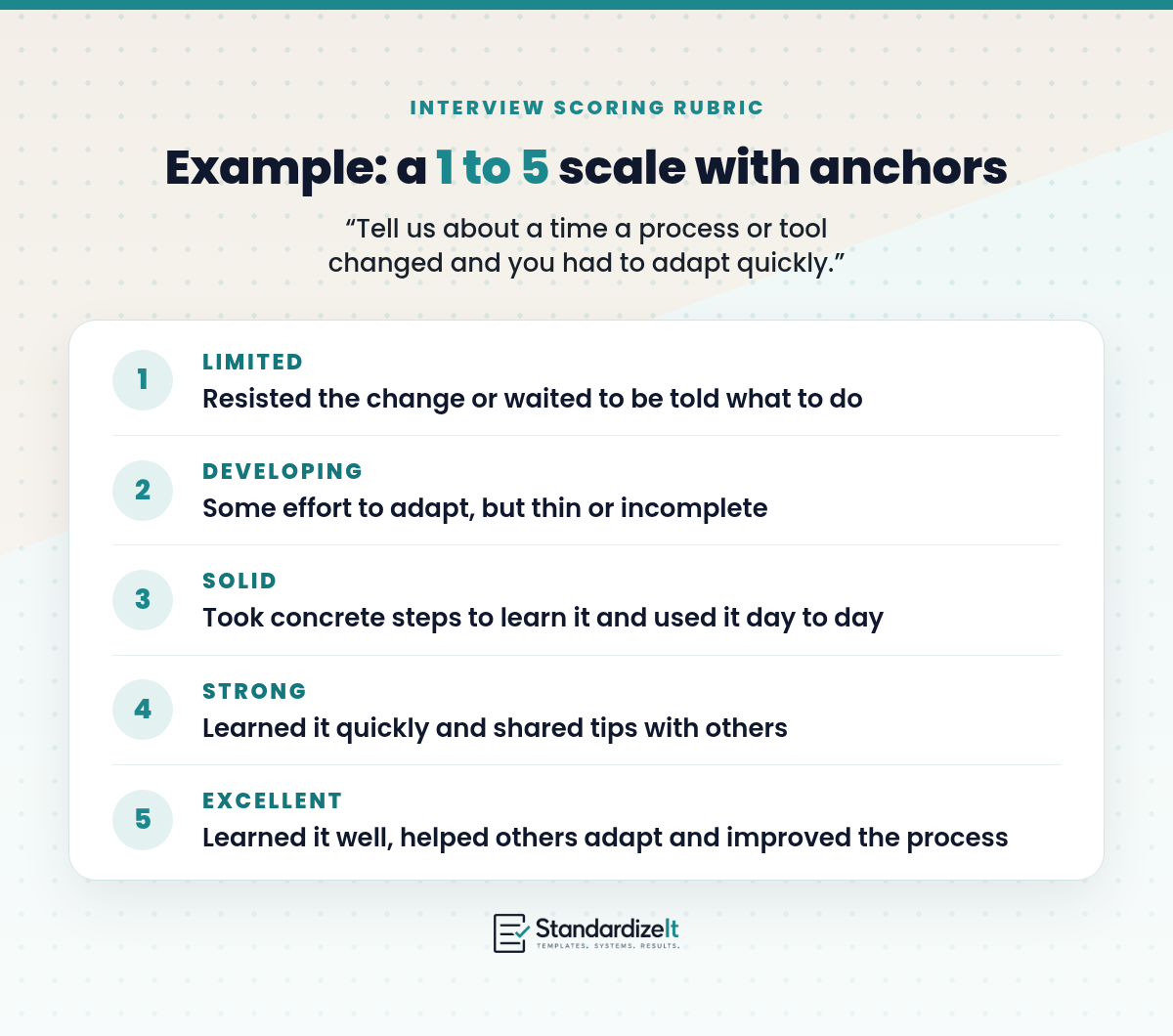
An interview scoring rubric turns “I liked her answer” into something you can compare. Use a 1-to-5 scale and write what a 1, 3 and 5 look like for each question, with 2 and 4 in between. Here’s an example for “Tell us about a time a process or tool changed and you had to adapt quickly”:
| Score | What it looks like |
|---|---|
| 1: Limited | Resisted the change or waited to be told what to do |
| 2: Developing | Some effort to adapt, but thin or incomplete |
| 3: Solid | Took concrete steps to learn it and used it day to day |
| 4: Strong | Learned it quickly and shared tips with others |
| 5: Excellent | Learned it well, helped others adapt and improved the process |
Put all the competencies on a one-page scorecard with space for a score and evidence notes. If some competencies matter more than others, set the weighting now, before you meet anyone, and write it on the scorecard. An interview scorecard template saves you building the layout yourself.
During the interview: run it the same way every time
Open consistently
Use the same short opening for everyone: who’s in the room, how long it will take, the format and that you’ll be taking notes.
Same questions, same order, consistent follow-up probes
Ask the core questions in the same order, and use planned follow-up probes (“What was the result?”) evenly for everyone.
Take job-related notes only
Write down what the candidate said and did. Never note appearance, accent, age, family or other personal characteristics, even as a memory aid. Assume the candidate could one day see your notes.
Depending on where you operate, privacy law may give candidates the right to ask for the personal information you hold about them, which can include interview notes. That applies to federally regulated employers (and businesses in the territories) under PIPEDA, and to private-sector employers in BC and Alberta under their provincial privacy laws (BC PIPA, Alberta PIPA).
Offer accommodation, and discuss it if the candidate raises it
Human rights laws across Canada require employers to accommodate candidates, for example for a disability, up to the point of undue hardship, and that includes interviews and tests. In Ontario and Manitoba, accessibility rules also require employers to tell applicants that accommodation is available. The guide builds that step into the interview invitation. (Sources: Canadian Human Rights Act, Ontario Human Rights Code, Ontario Integrated Accessibility Standards, Manitoba Accessible Employment Standard.)
Mention accommodation in every invitation, work out any request with the candidate (extra time, a different format), and don’t let it affect their score.
Leave time for their questions and explain next steps
Close the same way each time: invite their questions, then say when they’ll hear back.
What questions should you avoid in a Canadian job interview?
What people call “illegal interview questions” in Canada are usually small talk that wanders. The safest habit: if a question isn’t about the job, don’t ask it.
Protected grounds, in general terms
Every jurisdiction’s human rights law lists personal characteristics you can’t base hiring decisions on, and the lists differ. For example, political belief is protected in BC and Nova Scotia, source of income in Alberta and Nova Scotia, and criminal-record protections vary between the federal, Ontario and BC laws. The guide flags topics to steer clear of and reminds you to check your own province.
In general, keep these topics out of the interview: age or date of birth, marriage or family plans, childcare, pregnancy, religion, ethnic or national origin, disability or health, sexual orientation, and gender identity or expression. Asking whether someone is legally entitled to work in Canada, meets a legal minimum age, or can do the essential duties or schedule (with accommodation if needed) is generally fine.
If you’re a federally regulated employer, federal rules apply. Federally regulated employers, such as banks, airlines, interprovincial trucking and bus companies, railways, telecom and broadcasting companies, and most federal Crown corporations, follow the Canadian Human Rights Act for hiring. The Government of Canada keeps an official list of federally regulated industries.
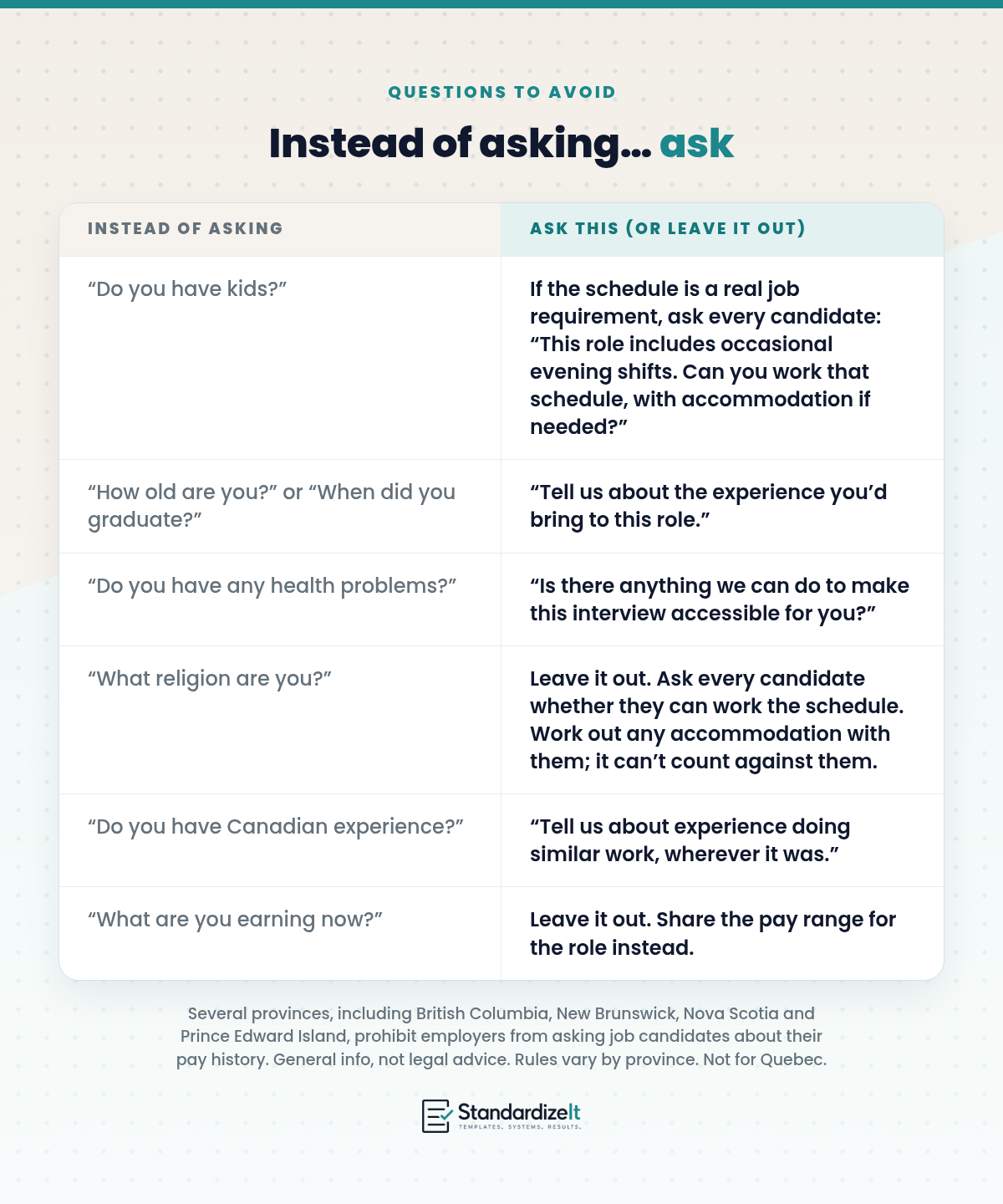
Instead of asking… ask…
| Instead of asking… | Ask this (or leave it out) |
|---|---|
| “How old are you?” or “When did you graduate?” | “Tell us about the experience you’d bring to this role.” Don’t ask a candidate’s age. If the job has a legal minimum age, ask only whether they meet it, for example ‘Are you at least 18?’ when the law requires 18 for that work. |
| “Are you close to retirement?” | “What are you looking for in your next role?” |
| “Do you have kids?” or “Do you plan to start a family?” | If the schedule is a real requirement of the job, describe it and ask every candidate: ‘This role includes occasional evening shifts and some overnight travel. Can you work that schedule, with accommodation if needed?’ |
| “Who looks after your children when you work?” | Leave it out. If the schedule is a real requirement of the job, describe it and ask every candidate whether they can work it. |
| “Where are you from?” or “Is that an accent?” | Leave it out. If work status matters, ask about eligibility to work. Ask: ‘Are you legally entitled to work in Canada?’ Human rights commissions in Ontario, BC, Alberta and Saskatchewan list this as an acceptable question. |
| “Are you a Canadian citizen?” | Ask: ‘Are you legally entitled to work in Canada?’ (Ontario’s Code allows citizenship questions only in narrow cases, such as when a law requires citizenship for the job.) |
| “Do you have Canadian experience?” | “Tell us about experience you’ve had doing similar work, wherever it was.” |
| “Do you have any health problems or disabilities?” | “Is there anything we can do to make this interview accessible for you?” Instead, describe the job’s essential duties and ask whether the candidate can perform them, with accommodation if needed. For example: ‘This role involves lifting boxes of up to 20 kg throughout the shift. Can you do that, with accommodation if needed?’ Don’t ask about health conditions or disabilities. |
| “What religion are you?” or “Which holidays do you take?” | Leave it out. Describe the schedule and ask every candidate whether they can work it. If someone needs accommodation, for example for religious observance, work it out with them. It can’t count against them. |
| “What are you earning now?” | Leave it out and share the pay range for the role instead. Several provinces, including BC, New Brunswick, Nova Scotia and PEI, prohibit employers from asking job candidates about their pay history. |
| “Have you ever been arrested?” | Leave it out. Never ask about arrests or charges. If a criminal record is genuinely relevant to the job, ask a narrow question that fits your jurisdiction’s rules. The Ontario Human Rights Commission, for example, suggests ‘Have you ever been convicted of a criminal offence for which a pardon has not been granted?’ It also recommends doing any police record check only after a conditional job offer. In Ontario, police record checks need the candidate’s written consent. |
If a candidate volunteers personal information, don’t probe and don’t let it affect the score.
Ontario Human Rights Code interview questions and Ontario hiring rules
If you hire in Ontario, a few extra rules apply:
- Job-posting rules (25+ employees). Since January 1, 2026, Ontario employers with 25 or more employees must include the expected pay or pay range in publicly advertised job postings (with some exceptions, such as roles paying over $200,000), disclose whether AI is used to screen, assess or select applicants, and state whether the posting is for an existing vacancy. (Sources: Employment Standards Act, 2000, Part III.1 and O. Reg. 476/24.)
- Canadian experience. In Ontario, employers with 25 or more employees can no longer list Canadian experience requirements in public job postings or application forms (since January 1, 2026). The guide helps interviewers assess skills and experience wherever they were gained.
- Following up after interviews. Since January 1, 2026, employers with 25 or more employees must tell every candidate they interview for a publicly advertised job whether a hiring decision has been made, within 45 days of the last interview. The guide includes a follow-up step to help you track it.
- Interview questions under the Code. Ontario’s Human Rights Code says application forms and written or oral questions to applicants can’t directly or indirectly classify candidates by a protected ground (s. 23(2)). Questions about a protected ground are allowed at an interview only where the Code itself permits that kind of distinction, such as a genuine job requirement (s. 23(3)).
- OHRC guidance on Canadian experience. The Ontario Human Rights Commission’s policy (guidance, not a statute) says a strict ‘Canadian experience’ requirement is discriminatory on its face and can be used only in very limited circumstances, where the employer can show it’s a genuine requirement of the job.
More official sources: Ontario ministry guide to publicly advertised job postings, OHRC: Interviewing and making hiring decisions.
Check your province or territory
Rules change, so check the source for your jurisdiction:
- Ontario: Ontario Human Rights Commission and the Human Rights Code
- Alberta: Alberta Human Rights Commission, pre-employment inquiries
- British Columbia: BC Office of the Human Rights Commissioner, equitable hiring infosheet and the BC Human Rights Code
- Saskatchewan: Saskatchewan Human Rights Commission, guide to application forms and interviews
- Federally regulated employers: Canadian Human Rights Act
- Manitoba, the Atlantic provinces and the territories: check your provincial or territorial human rights commission.
Not legal advice. This article is general information, not legal advice. Review your province’s or territory’s human rights legislation and get professional advice for your situation.
After the interview: score, compare and decide
Score independently before discussing
If two or more people interviewed, each completes their own scorecard before the debrief. Otherwise the most senior or confident voice quietly sets everyone’s scores.
Compare against the rubric, not gut feel
Rank candidates only on the competencies and weighting you set in advance, then write down the job-related reason for each decision. “Not a fit” and “overqualified” are vague, and vague reasons can hide bias and are hard to explain later.
Keep records securely and confidentially
Keep the posting, questions, rubric, scorecards, notes and decision in one competition file, with access limited to those who need it. Keep accommodation or medical details separate from the scorecards.
How long should you keep interview notes? It depends on where you hire. Ontario employers with 25+ employees must keep public job postings for 3 years, and BC’s private-sector privacy law requires keeping information used to make a hiring decision for at least a year. The guide prompts you to set a written retention period. Your lawyer can confirm the right one. (Sources: Ontario Employment Standards Act, s. 15, BC Personal Information Protection Act, s. 35.)
Next steps: offer letter, then onboarding
Then plan the first week. Our new hire onboarding checklist keeps day one organized, and an employee handbook template for Canadian businesses puts your policies in one place. Tell the other candidates promptly.
Get the Structured Interview Guide and Scorecard
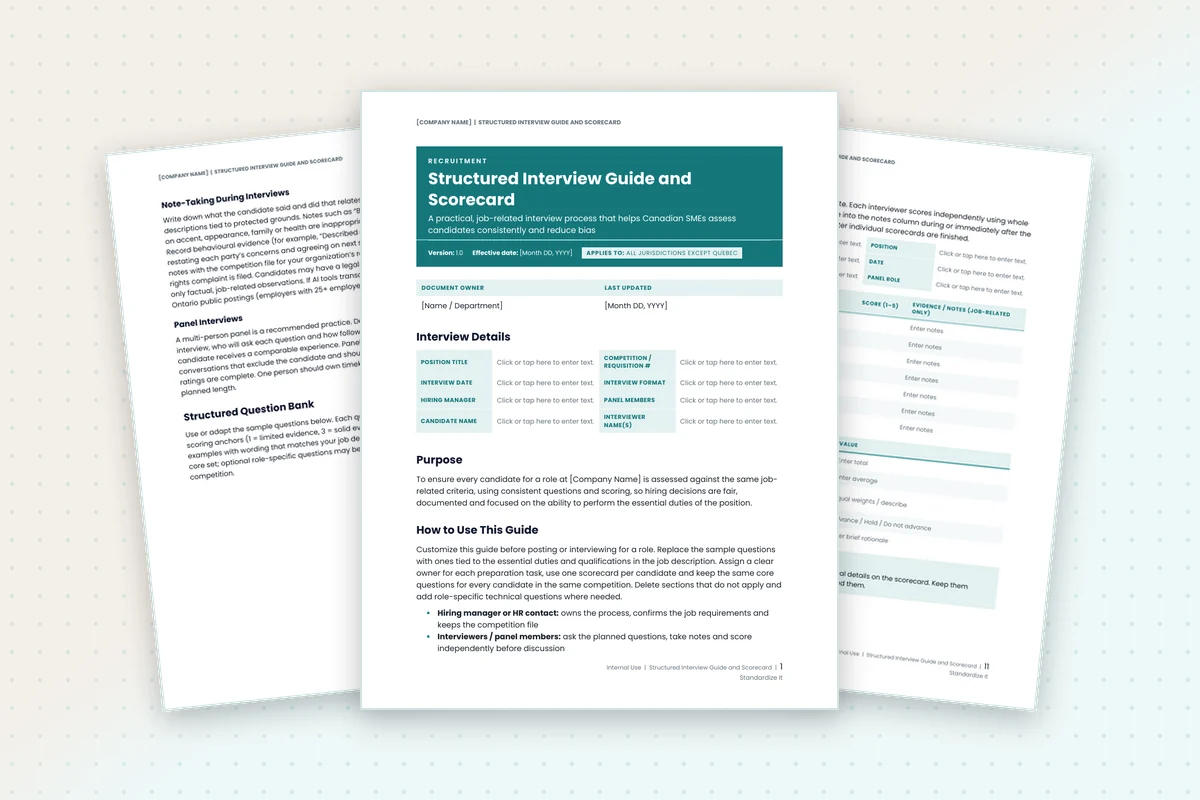
A ready-to-customize interview guide template for hiring managers: interview questions, an answer guide and a 1–5 scoring rubric, built for Canadian small businesses. It’s a fillable Word template with a pre-interview checklist, a question bank with scoring anchors, a candidate scorecard, a panel consolidation sheet and decision documentation, designed to reduce bias with consistent questions and scoring. Get the template → · Or unlock every template with Pro Membership.
FAQ
What questions are illegal to ask in a job interview in Canada?
There’s no single national list: each province, territory and the federal jurisdiction has its own human rights law, and protected grounds aren’t the same everywhere. For example, political belief is protected in BC and Nova Scotia. As a rule, avoid questions about age, family plans, pregnancy, religion, origin, health or disability, sexual orientation and gender identity or expression, and check the human rights commission for your province, territory or, if you’re federally regulated, the Canadian Human Rights Act.
Can I ask a candidate’s age in an interview in Canada?
Avoid asking age, date of birth or graduation year, or anything that hints at it, such as “Are you close to retirement?” Minimum working ages are set province by province (and federally for federally regulated work), and they often depend on the type of work. Human rights commissions in Ontario, BC, Alberta and Saskatchewan say you can ask whether a candidate meets the legal minimum age for the job, but not their actual age or date of birth.
Can I ask if someone is legally entitled to work in Canada?
Yes. Human rights commissions in Ontario, BC, Alberta and Saskatchewan say you can ask ‘Are you legally entitled to work in Canada?’ Don’t ask about citizenship, place of birth or immigration status. Ontario’s Human Rights Code allows citizenship questions only in narrow cases, such as when a law requires citizenship for the job or for chief or senior executive roles. Ask every candidate the same question.
What is the difference between a structured and an unstructured interview?
A structured interview asks every candidate the same job-related questions in the same order and scores answers against a rubric set in advance. An unstructured interview is a free-flowing conversation that changes from person to person. Structure makes fair comparison easier and leaves a written record.
How do you score an interview? What is an interview scoring rubric?
An interview scoring rubric is a scale, usually 1 to 5, with a short description of what a weak, solid and strong answer looks like for each question. Each interviewer scores every answer against it independently, adds evidence notes, and only then compares scores with the panel. Set any weighting before the interviews start.
How many interview questions should I ask?
For most small-business roles, one main question for each of four to six competencies, plus a role-specific technical question and a couple of closing questions, is plenty. That leaves room for follow-ups. Whatever the number, ask every candidate the same set.
Do I need an HR department to run a fair interview?
No. You need a clear list of job duties, job-related questions, a scoring rubric written in advance and the discipline to use them the same way with every candidate. Still check the rules in your province or territory, and get advice for tricky situations.
Want more ready-to-use tools? Browse all HR templates.
Standardize It templates are general resources for employers outside Quebec. They’re not legal advice and don’t guarantee compliance. Rules vary by province, territory and federal jurisdiction and change often, so check current requirements or talk to an employment lawyer before use.
